
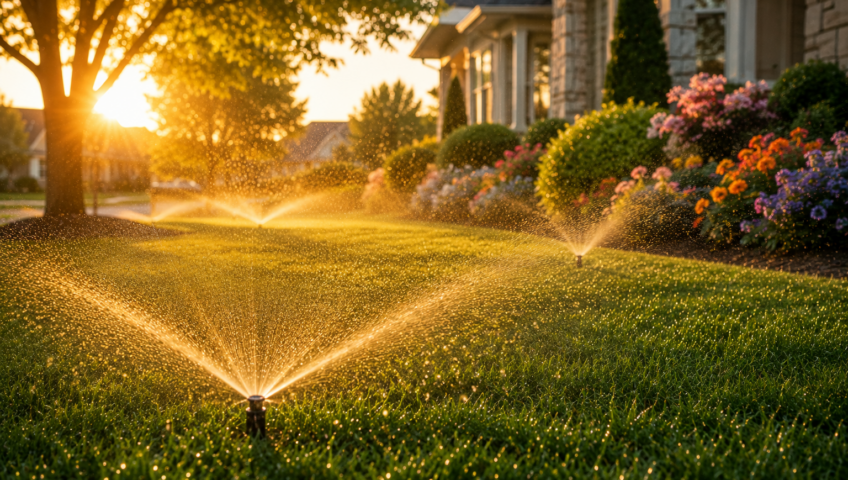
Watering your grass at night makes sense on the surface. The sun is down, the air is cooler, meaning less water evaporates. So, watering at night should be better, right? Well, not usually.
For most West Michigan lawns, watering grass at night is not the best routine, especially with overhead sprinklers. The issue is not that water touches the grass after dark, it’s that grass blades can stay wet for hours. In warm, humid summer weather, that long wet period can increase disease pressure and leave your lawn weaker than it needs to be.
There are exceptions. If water restrictions limit your schedule, or you are using root-zone irrigation in planting beds, nighttime watering may be part of the plan. But, for a normal residential lawn in Grand Rapids, the better answer is simple: water early in the morning.
This guide explains why night watering causes problems, when it’s acceptable to water, how much water your lawn needs, and how a properly programmed sprinkler system makes the schedule automatic.
The Short Answer: Morning Beats Night
If you only need the quick answer, here it is:
The best time to water grass in West Michigan is early morning, before the heat and wind pick up.
Michigan State University (MSU) Extension recommends morning to early afternoon as the best watering window. If daytime watering restrictions are in place, MSU notes that watering between midnight and daybreak is the better alternative.
That advice lines up with what we see in the field. Your lawn needs water in the soil, but it also needs the blades to dry. Morning watering gives your sprinkler system a cooler, calmer window while still giving the lawn time to dry during the day.
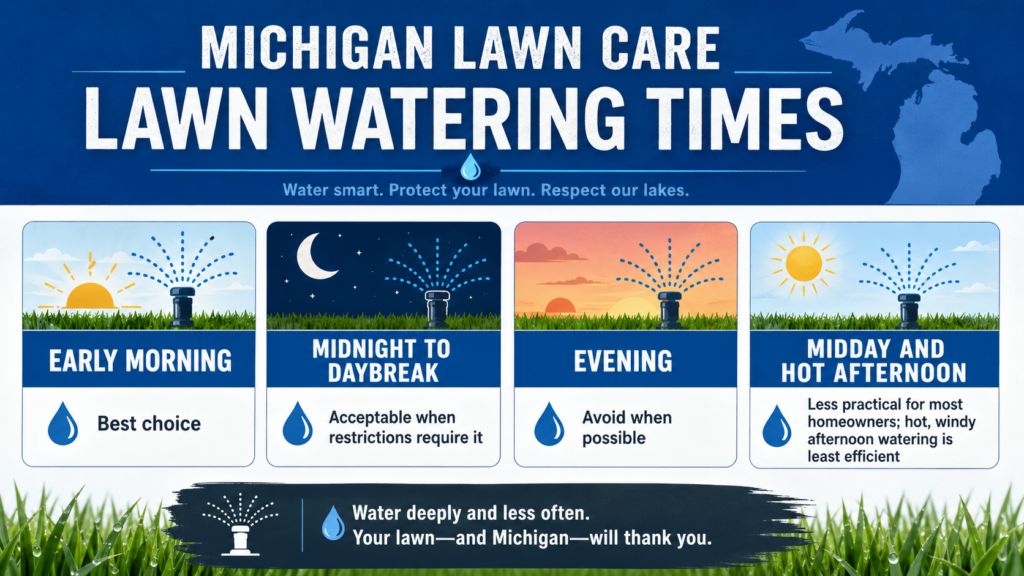
Here is the practical timing breakdown:
Early morning is the best choice.
This gives water time to soak in before the day gets hot, and it lets the grass dry afterward.
Midnight to daybreak is acceptable when restrictions require it.
If local water rules limit daytime watering, this is the better night option because the lawn is closer to morning drying time.
Evenings should be avoided when possible.
Watering after dinner can leave grass wet throughout the entire night.
Middays are usually inefficient.
Heat and wind can waste water before it reaches the root zone.
Why Watering Grass at Night Can Cause Problems
Night watering is not automatically destructive. A single late watering will not ruin your lawn.
The problem is repeated overhead watering when the grass stays wet for too long.
West Michigan summers can bring hot days, humid nights, heavy dew, and stretches where rain is uneven from one neighborhood to the next. A lawn in East Grand Rapids, Ada, Byron Center, or Grandville may not dry the same way as a property closer to the lakeshore or on sandy soil.
That local variation matters, but the principle is the same: long periods of leaf wetness create better conditions for disease.
Fungal Disease Pressure
The cool-season grasses common in Michigan lawns, including Kentucky bluegrass, perennial ryegrass, and fescues, can all struggle when heat, humidity, and excess moisture stack up.
Common disease names homeowners may hear include:
- Dollar spot
- Brown patch
- Pythium blight
- Red thread
- Rust
You do not need to diagnose the disease yourself. Watch for the symptoms such as circular brown patches, greasy-looking spots, thinning areas, orange dust on shoes after walking the lawn, or white/gray fuzz visible in morning dew.
MSU’s turf disease guidance specifically notes that heavy watering can increase the severity of Pythium blight, and that nighttime watering should be avoided during hot, humid disease-pressure periods.
That does not mean every wet lawn has Pythium; it means watering timing matters when the weather is already pushing the lawn toward stress.
Shallow Root Growth
The second problem is frequency.
Many homeowners water too lightly and too often. A short sprinkler cycle every evening keeps the surface damp, but it does not reliably push water deep into the root zone. The grass learns to live near the surface, where it dries out faster and struggles more during hot weather.
A healthier lawn is trained with deeper, less frequent watering. The goal is to move water into the soil, then let the roots search for it.
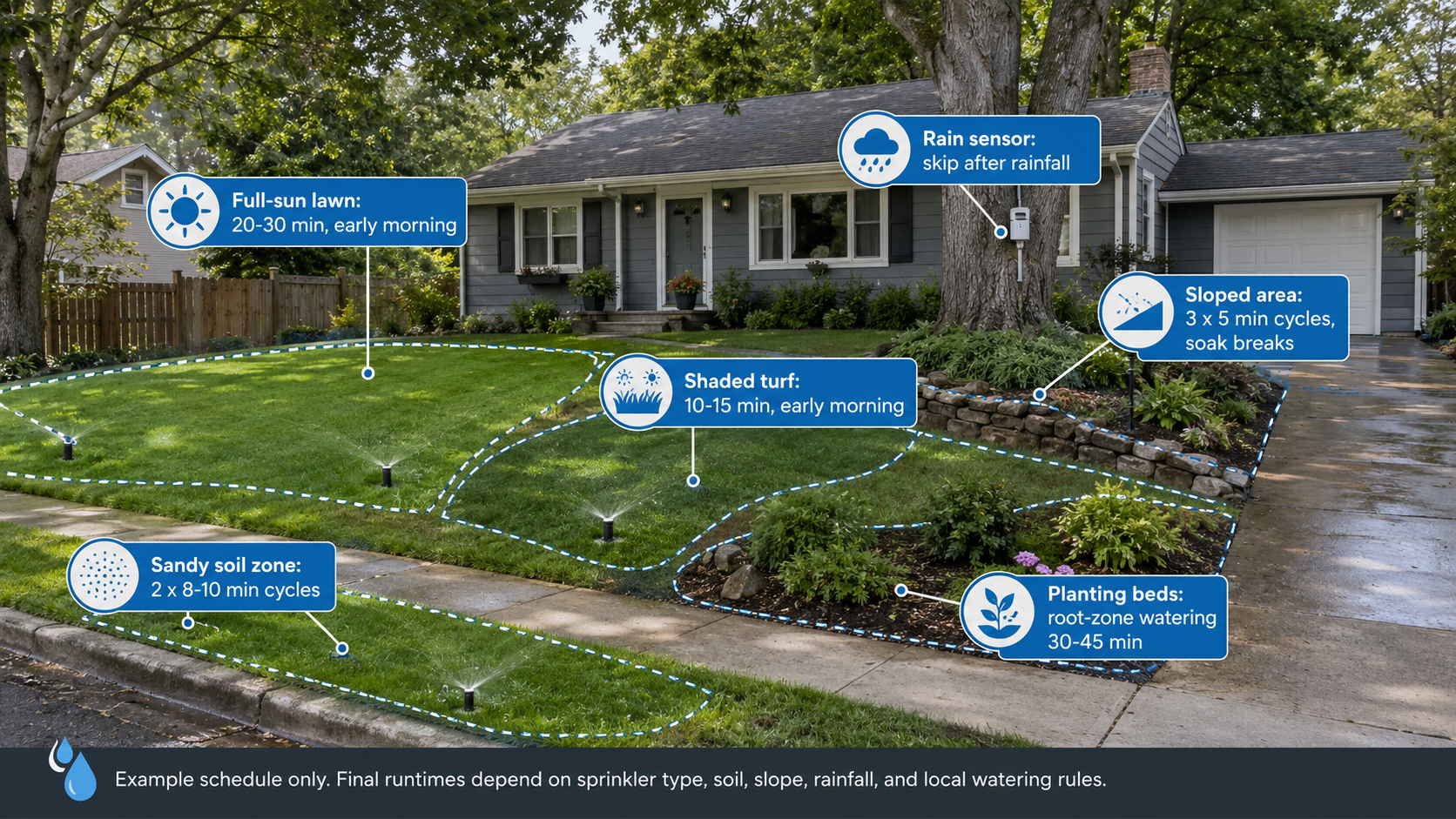
That is one reason a properly designed sprinkler system matters. The right schedule is not the same for every zone. Full-sun lawn, shaded side yards, slopes, garden beds, and sandy soil all need different run times.
Runoff and Waste
Night watering can also hide problems.
If a head is broken, a valve is stuck, or a zone is running too long, you may not notice until the next morning. By then, water may have run down the driveway, pooled in a low spot, or soaked the same section of turf for hours.
Signs your schedule is off include:
- Water running into the street or driveway
- A soggy, spongy lawn
- Mushrooms or algae
- A zone that is greener than the rest of the lawn
- Brown patches despite frequent watering
- Higher-than-normal water bills
If those problems show up, the answer is not always “more water.” Sometimes the answer is a repair, a zone adjustment, or controller programming.
When Watering at Night Is Actually Okay
This is where most lawn advice gets too simple.
“Never water at night” is easy to remember, but real yards have real constraints.
Night watering can be reasonable in a few cases.
Water restrictions limit your schedule.
During drought or water-system stress, communities may limit sprinkling by day or time. The Grand Rapids Metropolitan Area has a recommended water-use restriction policy that includes odd/even sprinkling tiers and a midnight-to-noon restriction tier. Nearby communities may issue their own temporary rules. In 2026, for example, Wyoming used an odd/even outdoor water restriction from May 1 until it was lifted, effective May 28. Always check your current local rules before programming your controller.
You are using root-zone irrigation in planting beds.
Low-volume watering at the soil level waters roots instead of spraying foliage. For garden beds, shrubs, and foundation plantings, that makes a major difference.
You are establishing new seed or sod.
New lawns may need more frequent watering for a short period. Follow the instructions from your installer and any local restrictions, then shift to deeper, less frequent watering as the lawn matures.
The lawn will dry soon after.
Watering closer to daybreak is different from watering at 9 p.m. The closer the watering is to sunrise, the sooner the blades can dry.
The main thing to avoid is making evening overhead watering your normal routine.
How Much Water Does a Michigan Lawn Need?
For most established lawns that you want to keep green and actively growing through hot, dry weather, plan around about 1/2 inch to 1 1/2 inches of water per week, including rainfall.
That is a range, not a fixed rule. Your lawn’s actual need depends on:
- Soil type
- Sun exposure
- Slope
- Turf type
- Recent rainfall
- Wind exposure
- Whether the lawn is established, newly seeded, or newly sodded
- Whether the lawn is meant to stay green or allowed to go dormant
MSU Extension notes that some lawns can be allowed to go dormant in summer. Dormant grass may turn brown during extended dry conditions, and MSU recommends occasional light watering during long droughts to keep dormant plants alive. If you want a consistently green, actively growing lawn, irrigation becomes more important during dry weeks.
The best way to measure output is simple: place a few small containers or rain gauges in the zone and run the sprinklers. See how long it takes to collect about a half inch of water. That tells you far more than guessing by minutes.
Many systems benefit from two deeper watering days per week rather than short daily watering. Sandy soils may need shorter, split cycles because water moves through quickly. Heavier soils may need cycle-and-soak programming, so water has time to absorb instead of running off.
Grand Rapids and West Michigan Lawn Factors
Grapids has worked on irrigation systems in Grand Rapids and across West Michigan since 1957. One thing that has not changed is our mindset that no two properties water exactly the same.
Here are the local factors that matter most.
Sandy Soil Drains Fast
Parts of West Michigan have sandy soil that drains quickly. That can be good for preventing standing water, but it also means the root zone may dry faster during hot weeks.
On sandy sites, the solution is not necessarily longer and longer watering. It may be shorter cycles with enough frequency to keep the root zone supplied without wasting water below it.
Clay and Compacted Areas Hold Water
Other properties, especially around new construction or low-lying areas, hold water much longer. These zones can become soggy if they are programmed like the rest of the lawn.
If water is pooling, the system may need shorter run times, head adjustments, drainage work, or a zone-by-zone schedule change.
Lake-Effect Weather Is Not Consistent
West Michigan weather can be uneven. One area gets rain while another stays dry. A system that runs on the same schedule all summer can easily overwater one week and underwater the next.
That is where rain sensors, Wi-Fi controllers, and seasonal schedule changes help.
Smart Controllers Make the Timing Easier
Most homeowners know morning watering is better.
The hard part is doing it consistently.
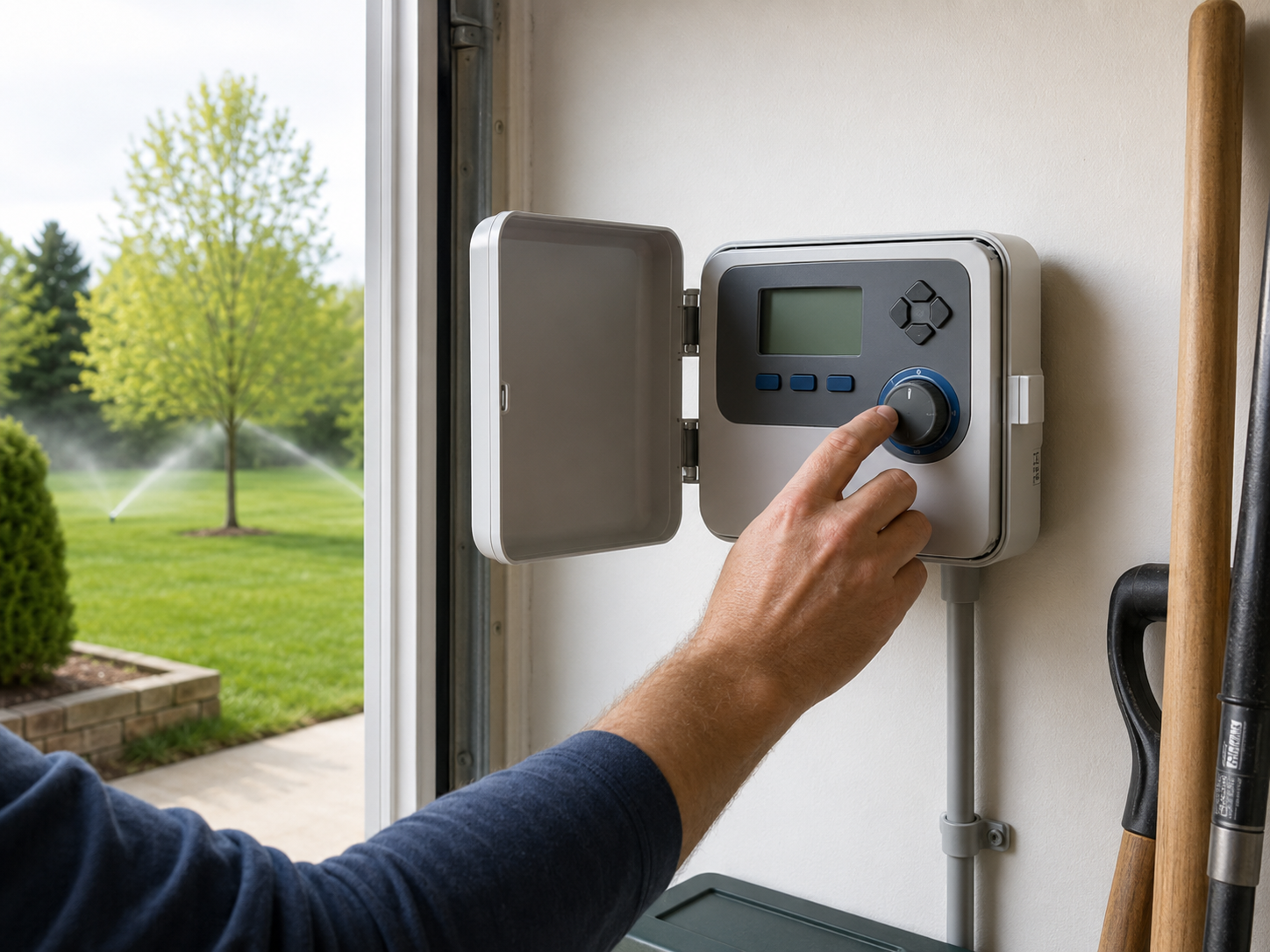
A controller solves that problem. A properly programmed sprinkler system can water before your day starts, run each zone for the right amount of time, and adjust as conditions change.
Grapids’ spring start-up service includes a complete reset of controller programming, start times, and run times, plus rain sensor activation and testing. Mid-season visits include schedule adjustments and performance checks so the system keeps up with the hottest part of the year.
With a smart setup, your system can:
- Water early in the morning
- Skip watering after rainfall
- Adjust run times by zone
- Avoid overwatering shaded areas
- Reduce runoff on slopes
- Keep planting beds off overhead spray when root-zone watering is the better fit
- Help spot issues before they become bigger repairs
That is the difference between “sprinklers run” and “the lawn is being watered correctly.”
Signs Your Lawn Is Being Watered Wrong
If you are not sure whether the problem is timing, amount, or system coverage, start with what the lawn is showing you.
Signs of underwatering:
- Footprints stay visible after walking across the grass
- Blades curl or fold
- Grass turns blue-gray before browning
- Sunny areas dry out much faster than shaded areas
- Soil is dry below the surface
Signs of overwatering or poor timing:
- Mushrooms appear regularly
- The lawn feels soft or spongy
- Water runs off instead of soaking in
- A few areas stay wet while others dry out
- Brown patches spread during humid weather
- The lawn is still wet late into the morning
Sprinkler system problems can look like lawn problems. A dry patch may be a blocked head. A disease-prone area may be a zone running too long. A constantly wet corner may be drainage, not irrigation.
That is why a system inspection is often the fastest way to stop guessing.
When to Call Grapids
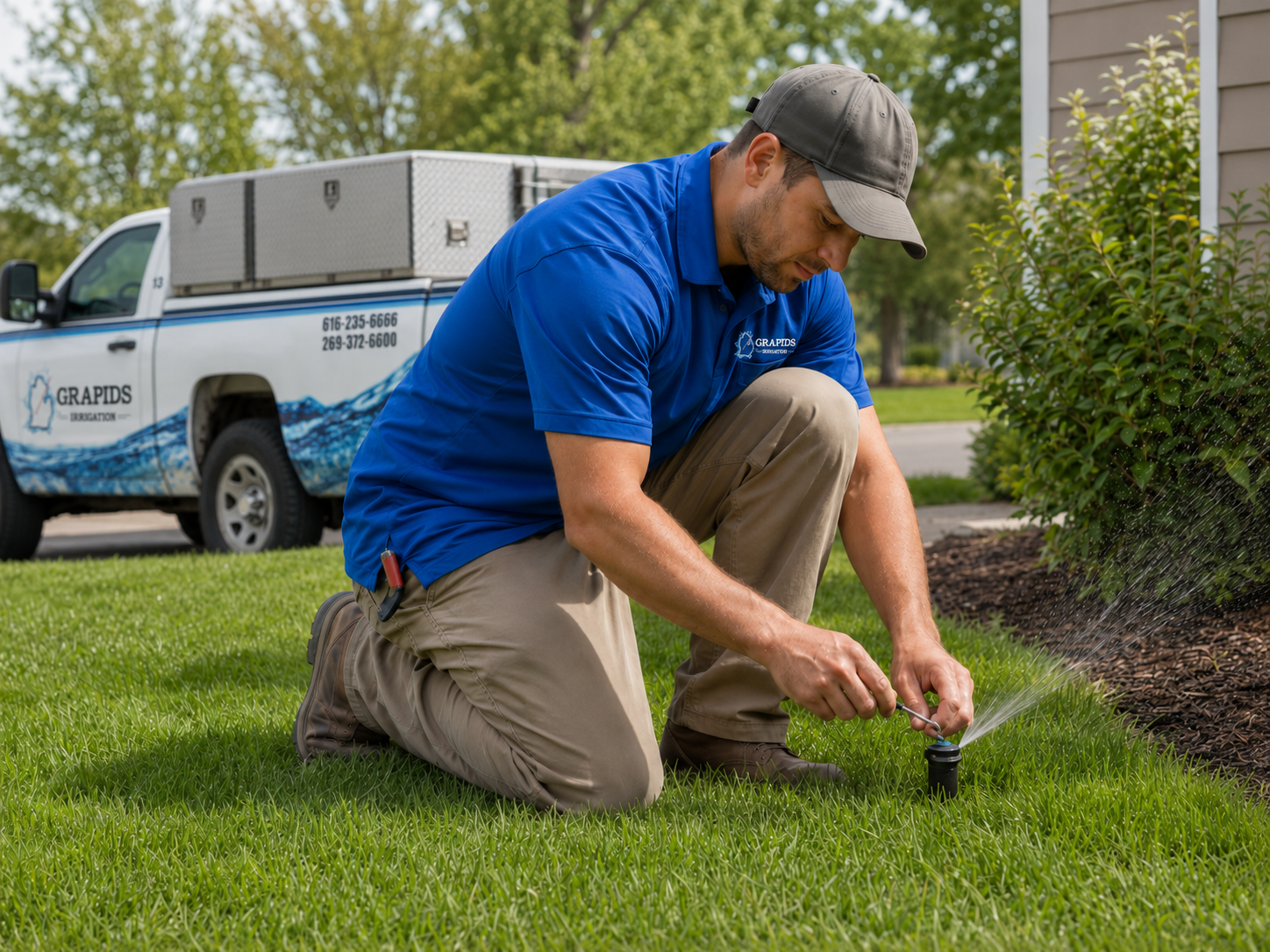
If your lawn has the same dry spots every summer, your controller is still set from last year, or your system runs but the yard still looks uneven, it is time to have the system checked.
Grapids Irrigation installs, repairs, starts up, winterizes, and maintains sprinkler systems across Grand Rapids and West Michigan. Since 1957, three generations have focused on irrigation systems for residential, commercial, sports fields, and public properties.
We can help with:
- Controller programming
- Spring start-up
- Mid-season adjustments
- Broken heads and poor coverage
- Rain sensor testing
- Wi-Fi controller setup
- Sprinkler system repair
- New system installation
- Fall winterization
If your watering schedule is the issue, we will help fix the schedule. If the system itself is the problem, we will show you what is happening and what it takes to correct it.
Lawn Watering FAQs
Is it bad to water grass at night?
It can be. Watering grass at night with overhead sprinklers can leave grass blades wet for hours. In warm, humid weather, that can increase disease pressure. Early morning is usually the better routine.
Should you water grass at night?
Only when there is a practical reason, such as a local water restriction or new lawn establishment. If restrictions require night watering, aim closer to midnight or daybreak rather than early evening.
Is 9 p.m. too late to water grass?
Usually, yes. A 9 p.m. sprinkler cycle can leave grass wet through most of the night. If you have an automatic controller, program lawn zones for early morning instead.
What is the worst time to water grass?
Watering in the evenings poses the highest risk of disease because the lawn may stay wet all night. Middays are usually the worst for water waste because heat and wind reduce sprinkler efficiency.
How long should I water each sprinkler zone?
It depends on the zone. Head type, soil, slope, pressure, and sun exposure all matter. Use rain gauges or small containers to measure output, then program the zone around water delivered, not just minutes on the controller.
How much water does a Michigan lawn need?
Most established lawns need about 1/2 inch to 1 1/2 inches per week, including rainfall, when you want them to stay green and actively growing through hot, dry weather. Some lawns can be allowed to go dormant during summer dry spells.
Can I water at night with a sprinkler system?
You can, but it should not be the default for most lawn zones. A sprinkler controller is most useful when it is programmed for early morning watering, with rain sensors or smart controls to avoid unnecessary cycles.
What time should sprinklers come on?
For most Grand Rapids lawns, early morning is the best routine. If local restrictions prohibit daytime watering, midnight to daybreak is the better alternative.